
Case studies / Supply chain
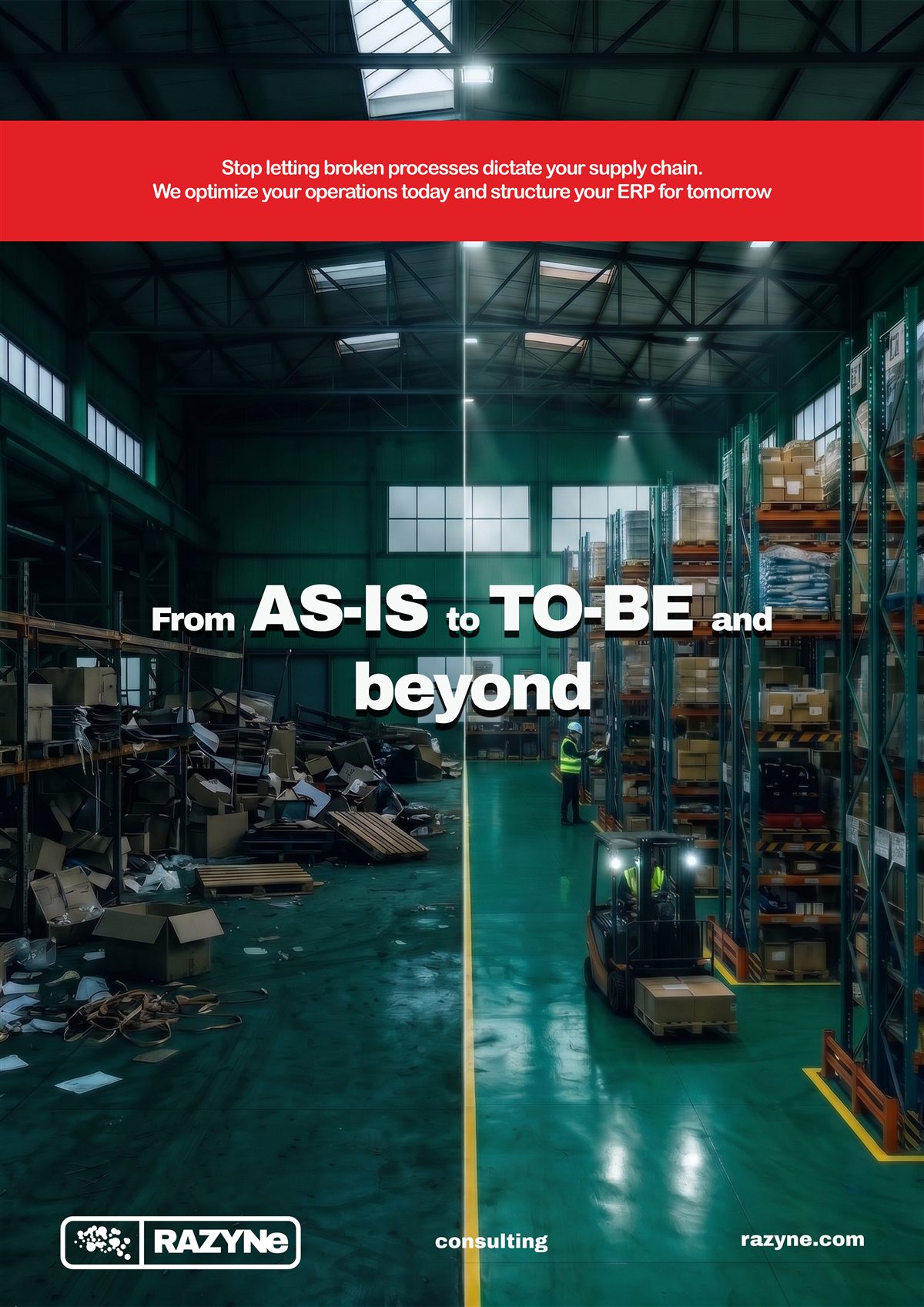
Case study · Supply chain
From operational disorder to structured warehouse management.
An ERP extension and business process transformation, built around Sage X3 instead of replacing it.
- Industry
- Logistics
- Focus
- Procurement, warehouse, ERP extension
- ERP
- Sage X3
- Stack
- Rust application, relational database, API integration, Windows Server
- 4 rolesreplace open access to stock
- 8 stepsof inbound, modeled in BPMN
- 1 ERPkept: Sage X3 extended, not replaced
01 / Executive summary
A pragmatic answer to a costly question.
A large logistics organization was struggling across its procurement and warehouse activities. Despite using Sage X3, warehouse operations lacked standardized procedures, clearly defined responsibilities, and reliable information management.
Replacing the ERP with a more warehouse-oriented platform, such as SAP or Microsoft Dynamics, was considered difficult and potentially costly. The project instead restructured the operational processes and developed a complementary application, while keeping Sage X3 as the central inventory system.
Project scope
- Procurement and replenishment processes
- Warehouse inbound and outbound operations
- Organizational structure and responsibility allocation
- Database architecture and application development
- API-based integration with Sage X3
02 / Initial situation
Understanding the challenges before touching the system.
Organizational challenges
- Responsibilities and individual missions were not clearly documented.
- Several employees had broad access to inventory information and operations.
- Employees understood their daily activities, but the overall division of responsibilities was unclear.
- Different departments used their own methods to manage information and documentation.
Warehouse challenges
- Overstocking and poorly organized storage areas.
- Inconsistent inbound and outbound procedures.
- Limited traceability of physical stock operations.
- Inbound and outbound documentation handled through handwritten records and separate Excel files.
Information-management challenges
- Product, supplier, and reference information scattered across multiple files.
- Supporting documents, including invoices and transport documents such as LTA, stored in different formats and locations.
- Sage X3 did not provide all the warehouse-specific information-management capabilities the teams required.
The problem was not simply a software limitation. It was a combination of process fragmentation, unclear responsibilities, and insufficiently structured operational data.
03 / Diagnosis & organizational transformation
Four roles, each with a clear owner.
The project began with an AS-IS assessment of activities, responsibilities, information flows, and bottlenecks. Team meetings and discussions with employees showed how work was actually performed and built a shared understanding of the objectives.
- Replenishment: identifying requirements, researching parts, and initiating purchasing needs.
- Inbound control: receiving supplies, checking references and quantities, inspecting conformity, labeling goods, and identifying their destination.
- Warehouse responsibility: overseeing the assigned warehouse and its stock organization.
- Picking: physical stock handling and inventory operations restricted to an authorized operator.
The purpose was to establish accountability, reduce unnecessary access, and create a more controlled operational environment.
04 / Process architecture
The inbound process, in eight steps.
- The replenishment function identifies the required part and its purpose.
- A purchase order is created in Sage X3, stating whether the need concerns replenishment or the technical department.
- The goods arrive at the receiving area.
- References, quantities, and conformity are checked.
- Goods are labeled with their internal information, destination warehouse, and purchase-order reference.
- The inbound information is recorded, and supporting documents are collected.
- The invoice and product reference are used to identify the matching purchase order.
- The documentation goes to invoicing for reconciliation and purchase-order closure.
Outbound process
- Stock requests follow a defined warehouse procedure.
- The warehouse responsible person oversees operations.
- The authorized picker physically handles the goods.
- Barcode scanning is part of the proposed outbound validation.
- Stock movements remain managed in Sage X3.
Future development: reverse logistics
For disputed or non-conforming goods, the proposed approach adds a dedicated quarantine area and a fiche de non-conformité (FNC) to improve isolation, documentation, and follow-up. This is a future improvement, not a completed implementation.
05 / Technical solution
Extending Sage X3 without replacing it.
A full migration to another ERP was hard to justify given the complexity, disruption, and investment involved. The project chose a complementary application that improves warehouse information management without duplicating the ERP's inventory role.
Custom application
- Parts and materials
- Supplier information
- Product references, and the internal reference assigned to each item
- Structured records users can search and retrieve
The replenishment function maintains the information; other operational users consult it.
Database and API integration
The team designed the database tables, relationships, and information structure, replacing fragmented spreadsheets with one structured repository. The application reads from Sage X3 through its API, while inbound records are entered in Sage X3, so the ERP stays the reference for inventory and stock movements.
Development and deployment
Built in Rust, functionally tested, compiled into a Windows executable, and deployed on a Windows Server environment.
06 / Business rationale
Why this approach?
The decision weighed operational value against implementation complexity and return on investment.
Full ERP replacement
Complementary application
Major migration project
Existing ERP preserved
Broader organizational disruption
Focused operational improvements
Higher implementation complexity
Targeted development
Replacement of established ERP processes
Existing inventory system retained
Larger transformation scope
More controlled investment
07 / Expected business benefits
What the design was built to deliver.
- Better organization of warehouse responsibilities
- More structured product and supplier information
- Improved information accessibility across departments
- Better traceability of inbound and outbound operations
- Less dependence on fragmented Excel files and handwritten records
- More controlled physical stock handling
- Continuity of Sage X3 as the inventory reference system
- A more economically pragmatic alternative to full ERP migration
These are expected benefits of the designed solution, not quantified or independently measured project results.
08 / RAZYNE's approach
Technology should adapt to a well-understood business process.
Not compensate blindly for an unstructured organization.
- Discover: understand the environment, objectives, and existing practices.
- Diagnose: identify organizational, process, and information-management weaknesses.
- Design: define responsibilities, workflows, data structures, and the target architecture.
- Evaluate: assess alternatives by technical feasibility, complexity, and ROI.
- Transform: support the development and deployment of solutions aligned with operations.